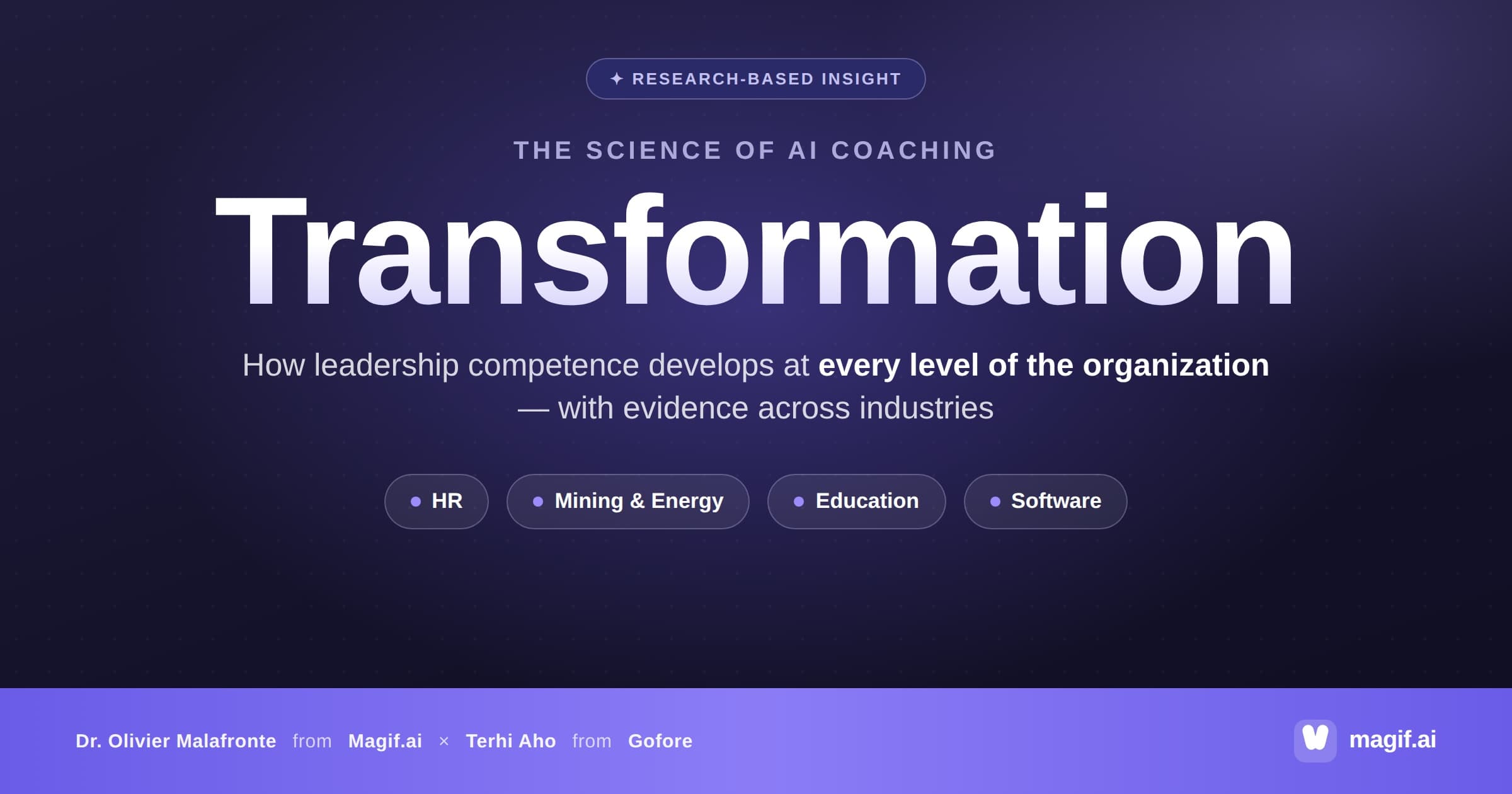
Earlier this year, Dr. Olivier Malafronte joined Gofore's AI advisor and coach Terhi Aho in Helsinki, for “Leading Transformation with AI.” The question on the table: what does it actually take to turn AI adoption into new ways of leading and working?
The blog post that followed — “Keep Humans at the Centre of AI Transformation,” co-written with Terhi — makes a simple claim. Transformation doesn’t fail at the strategy level. It doesn’t fail at the technology level either. It fails at the last mile, where knowledge has to become behaviour. That last mile is human, and it doesn’t close through reflection alone. It closes when reflection turns into practice.
That post was written for leaders and HR and L&D professionals who need the practical case of AI integrated into human transformation. This one goes into the research behind AI coaching, how it develops leadership competence, and why that development has to reach every level of an organization, not just the leaders lucky enough to get a coach. Research alone only shows what’s possible. So, this post also shows what it sounds like from the leaders themselves, and two examples — one trainer, one company — of what it looks like once it’s built.
What the research actually studied
Dr. Olivier Malafronte’s doctoral research is the first study to open the black box of AI coaching conversations with real managers and leaders on the field. Not a survey of how people feel about AI coaching. An examination of what actually happens, turn by turn, inside the conversation and based on a theoretical framework built upon decades of research on human development.
Over two research stages between 2022 and 2024 with near 190 participants across four organisations: an HR technology company in France, a mining and energy multinational in the UK, an online education company in the US, and a software provider spanning the US and France. 36 embedded case studies with multiple conversations, followed by individual interviews, to understand what was changing and why.
The findings are published in Management & Avenir (2024) and the Journal of Applied Behavioral Science (2026), and presented at the Academy of Management conferences in Europe and Africa.
Competence isn’t a trait. It’s a dynamic process of regulation in real-world situations.
The research starts from a different definition of leadership competence than most people grew up with. Not a fixed set of skills a leader either has or doesn’t. Developmental psychology treats competence as the ongoing regulation of “schemas” — the cognitive and affective patterns of thought, emotion, judgment and language through which a person interprets a situation and decides how to act.
Leaders don’t fail to communicate, manage stress, or make a hard decision because they lack a technique. They act from the schema they’re currently running, most of the time without noticing it or taking action on it, and this is the gap. Development happens when that schema shifts towards a more successful or empowering schema: when a leader takes a step back, reframes a situation, or considers someone else’s perspective before reacting, and applies it and reinforces it situation after situation.
This is exactly what coaching’s reflective questioning is built to do.
AI coaching as a reflective mirror and active guidance into real-situations
One finding stands out. In a companion paper — “Mediating reflectivity: AI coaching conversations as reflective mirror of relational orientations,” Journal of Applied Behavioral Science, 2026 — the research found that leaders don’t just reflect on themselves in these conversations. They socialize the issue. They bring in their team, their manager, their peers, the wider organization.
“The AI coach becomes a mirror not just for the leader’s own thinking, but for their relational and organizational context.”
Dr. Olivier Malafronte
That single finding is the bridge to the rest of this post. If a private, one-to-one reflective conversation naturally pulls in the team and the organization, leadership development was never really an individual-only intervention to begin with.
How reflection and practice become competence: the AIC Augmentation Loop
Across the conversations studied, the same pattern kept showing up, later formalised as the AIC (AI Coaching) Augmentation Loop, a framework grounded the Activity Theory, and established theory in human development for decades. Unlike models that treat coaching as a one-off intervention, the loop is cyclical, and it does not stop at insight. A leader brings a real situation and sets a goal. Reflective questioning surfaces the cognitive and affective schema at play. The coaching-like dialogue regulates that schema. The leader gains insight and awareness, often at more than one level: themselves, their team, their organization. They commit to an action and with repeated practice the competency itself gets augmented, carried into real leadership situations, including how that leader then interact and socialize with their own team.
Repeated across conversations, this loop was associated with measurable development across three categories of patterns of situations: managing the self (emotions, fears etc.), managing communication and relationship, managing work organization.
Leaders, in their own words
Verbatim excerpts from Malafronte (2025) PhD research participants, anonymized per academic and ethical protocols.
The theory surfaced through Dr. Olivier Malafronte (2025) helps understand that leadership competence is one’s or an organization’s ability to provoke and maintain schema change at the individual, collective and organizational levels through reflection put into practice with the self and the collective, which impact the organization. The research also has the actual words leaders used while that was happening, and they say a lot about what a leader’s role feels like from the inside.
Example 1: Feeling legitimate in a new role. One leader came to AI coaching newly promoted, exhausted, and carrying real self-doubt: “I do not always feel legitimate in my role as a leader.” Working through it with the AI coach, the leader moved from that starting point to changing how they ran their own processes and time, enough to feel less impatient and more in control of the role itself.
Example 2: Sharing a hard decision with a team. Another leader came in anxious, carrying a decision that would “shake up the team” and needing, in their own words, real “power of persuasion” to pass it. Rather than rehearsing an announcement, the AI coach helped the leader work through what the team actually needed to hear. The leader closed the conversation “more reassured, thinking all is possible” and the next action wasn’t a memo. It was meeting as a team.
Example 3: Leading through financial uncertainty. A third leader, worried about the company’s financing, used the AI coaching conversation to work out that the real lever wasn’t a spreadsheet — it was presence. The leader organized meetings, brought colleagues back on camera, and rebuilt team cohesion around the uncertainty rather than in spite of it. “The AI coach gave me the impression of understanding what I wanted to speak about,” the leader said afterward. “It gave me confidence.”
Example 4: Changing how a team experiences its leader. A fourth case is the clearest evidence yet that this isn’t only an individual outcome. A leader working on work-life balance realized, mid-conversation, that being “head down” had been “blocking decisions”, stopping them from seeing what was in front of them. Weeks later, in the interview, the leader reported something a purely individual intervention shouldn’t produce: colleagues now “know that, even if there are tensions, they can come to see me”, that the leader devotes time to them. The leader’s own schema change had rippled outward, into how the team experienced being led.
Example 5: Engaging stakeholders with a new approach. A fifth leader, tasked with bringing skeptical stakeholders along on a change in commercial practice, used the coaching conversation to notice a habit: years of defaulting to formal language, when the moment actually called for something closer and more informal. “It enables us to get out of a routine where we have habits,” the leader reflected. “Thanks to the questioning, it requires us to move away from over-oiled mechanisms, which cause us to miss things.”
Five different leaders, five different situations: a new role, a hard decision, a financial scare, a work-life collapse, a stakeholder relationship. The similarity across all of them is the mechanism this post has been describing: reflection can surfaces a schema, facilitates its regulation to help leaders to acts differently step by step, not just for themselves, but for the people around them.
Why leadership development has to work at every level of the organization
Leadership has long been understood in management research as a multilevel phenomenon. It exists at the individual, team, and organizational level simultaneously, and leaders only emerge when their own schemas align with their team’s and organization’s (Denis et al., 2000). Most leadership development is still designed as if it only happened at the individual level: a coach for the CEO, a workshop for the top team, and not much for anyone else. Not because organizations don’t want more. Because human coaching capacity cannot scale with headcount.
This is the part that matters most in practice. If competence is a schema regulation, and if schemas exist and interact at individual, collective, and organizational levels, then leadership development that stays confined to a handful of executives is structurally incomplete. It changes individual schemas without ever touching the collective and organizational ones they’re supposed to align with, or it only stays top-down as opposed to being also bottom-up and simultaneous from top and bottom.
The research insights mentioned above point to a different possibility — and it’s the one Magif.ai was built on. A coach’s or expert’s methodology — their language, their values, the questions they ask, the frameworks they mobilize, the way they respond to people’s cues, can be carried, through contextualized AI agents, from the leadership team down to managers and individual contributors, each reflecting in their own context, with the human coach staying at the centre: supervising, reviewing what emerges, adjusting the approach. Not “more tools.” A reflective infrastructure that finally reaches every level a schema actually needs to change at.
What that looks like in practice is different at each scale. Below are two examples: one trainer extending a leadership methodology into a program that reaches many leaders, and one company building reflection and practice into its infrastructure for an entire organization.
From research to practice: Three key additional examples for leadership and organizations
Maxime Bui, HEC Organizational Coach
Maxime Bui faces the same constraint most organizational coaches run into eventually: a coach can work with a CEO or an executive director, but the coaching culture that relationship builds rarely reaches the managers and teams underneath. The budget isn't there. The coach can't be everywhere. Maxime — an HEC-trained organizational coach and Magif.ai's own engineer-coach for audit, compliance, and the ethics of AI coaching — decided to test whether an AI agent could close that gap for one of his own clients.
The build
Maxime encoded his own coaching method into an AI coaching agent on Magif.ai — his language, his values, the questions he actually asks. Then he did what most coaches never get the chance to do: he extended that same methodology past the person paying for it, building it into the organization itself, contextualized for the people below the director he was coaching directly.
Level one: the team leader
The starting point was a stuck feedback dynamic — an agency director with a team member relationship that wasn't moving, and no clear way through it. Working with the AI coaching agent, the director reframed his entire approach: not just what he said in the next conversation, but how he showed up as a leader going into it.
Level two: the team member
On the other side of that same relationship was a team member in shutdown — not feeling good, disengaged, close to leaving. Through a session with Maxime's agent, that changed: personal clarity, recovered motivation, and a decision to stay. The employee didn't just want to stop there, either — they asked to go deeper.
"I preferred having the time to work with the AI. I didn't want to get a time rush with a coach having to close after an hour." — Team member, after a two-hour AI coaching session with Maxime's agent
The hybrid model
Nothing about this replaced what Maxime does. It extended it. Maxime kept coaching the director directly, human to human. The agent reached the team member — at a moment, and at a pace, Maxime himself couldn't have been there for. No time rush, no hour-long slot to fill and vacate. Just space, available when it was needed.
"I prefer this AI expertise coaching tool than ChatGPT — for the power of the method behind it." — Team member, on the difference methodology makes
Level three: the ecosystem
One conversation, two results — a director who changed how he leads, and an employee who nearly left and didn't. Both outcomes replicate Malafronte's own PhD findings directly, this time produced by someone else's methodology, inside someone else's client relationship, in the field. The director noticed too: he's now the one talking to other directors across his agency group about rolling Maxime's model out further, with a concrete budget representation behind it that matches with the leader’s organization capacity. One proof point. One ecosystem opening up.
Maxime is what the multilevel argument earlier in this post looks like the first time a single coach builds it into one real client relationship — before it's a training program, before it's a company-wide rollout. Michael Dunlop is what it looks like at the scale of a program reaching many leaders. Gofore is what it looks like applied to an entire organization.
Michael Dunlop, Leadership Development trainer in the public sector
Michael Dunlop has spent years teaching senior leaders how to navigate change. He is also, by his own description, “a bit of an AI skeptic from the start.” Years of LinkedIn noise — “AI is coming, you must use AI… we can help you to fire all your staff” — mostly from people with no real grounding in coaching or human connection, hadn’t helped. Neither had his own experiments with general-purpose chatbots: useful now and then, but often just “the average of what it’s scraped from the internet,” with enough hallucinated nonsense that fact-checking it ate up whatever time it saved.
He actually needed one. Coming into a Master Trainer program built to sharpen his own coaching and leadership-development competencies, Michael was given access to a set of AI coaching agents woven into the training itself, one to sharpen how he pitches an idea, one to model what separates strong performers from average ones, one built around trainer development itself, one to help him prepare and summarize his own sessions. He hadn’t personally come up through the program’s earlier practitioner track, and the gap was sitting with him, the same feeling the research keeps finding in leaders taking on a new role. “There was a bit of self-doubt about coming on as a master trainer,” he says, “not having experienced what it’s like to come through [that earlier stage of the program].”
What changed his mind
Not speed. What changed Michael’s mind was how deliberately the tool refused to just hand him an answer. “I’m a big believer that learning requires effort,” he explains. “If you just give me the answer and there it is — the speed is brilliant, but if you sacrifice speed for learning, you’ve got nothing from the experience.” Each concept came with an exercise, something to try rather than read — one, a simplified way to teach a notoriously difficult technique to a group, changed how he thinks about parts of his own program. Knowledge became understanding the moment he had to use it.
“The most positive experience I’ve had with AI ever.”
Michael Dunlop, Leadership Development TRAINER
That’s his verdict after two weeks working through all four agents. What set it apart from every general AI tool he’d tried, he says, was what it didn’t do: it never told him how brilliant he was, never buried him in pages of theory, never handed him a finished answer to a problem that was actually his to solve. “It’s not there to give you the answers,” he says. “It’s there to help you in your own thinking and to structure it.” When the pitch-refinement agent trimmed some of the passion out of his pitch, he pushed back and put it back in — because he trusted the tool enough to correct it. “It felt more of a tool that I was using to reflect my thinking,” he says, “and then I had permission to refine it.”
What this changed about how he sees AI and learning
The shift that matters isn’t that Michael became an AI enthusiast. It’s what he changed his mind about: whether AI could actually move someone from knowing something to doing it. For a trainer who believes “learning requires effort,” reflection on its own was never going to be enough — and that’s exactly what the agents didn’t let him settle for. Every concept came paired with something to practice, not just something to read, so what he learned didn’t stay as an idea in his head. It had to survive contact with a group, a pitch, a real session. That, in his view, is the actual value of an AI agent on the field: not the conversation itself, but what the conversation makes someone capable of doing afterward. “It’s not there to give you the answers,” he says. “It’s there to help you in your own thinking and to structure it.” The rest, as he sees it, is practice.
Gofore: what this looks like when a company builds it
Research shows what’s possible. Organizations show what it looks like in practice. Gofore is one of the clearest examples of a company treating reflection and practice as infrastructure — not a one-off program.
Terhi Aho, Gofore’s AI transformation advisor, has spent 25+ years leading large-scale digitalization and organizational change. Her two books, read together, describe almost exactly the meso- and macro-level dynamics this research points to: “Experimentation Culture” (2023), on why organizations that run many small, low-threshold experiments learn faster than those running the biggest transformation programs, and “AI as a Partner” (2025), on what it takes to make that true with AI specifically.
“The organizations that win aren’t the ones with the best AI, they’re the ones that learn faster than everyone else.”
Terhi Aho, Gofore TRANSFORMATION COACH
In the language of this research, that’s a description of an organization whose collective and organizational schemas are being continuously regulated, not just its individual leaders’ schemas.
The event itself was structured the way the science says it should be. “From Transformation to Learning” in the first half, grounding the room in what makes AI coaching and reflection work. “From Insight to Practice” in the second, with a live coaching demonstration and real-world applications, insight converted into action, in the room. That’s the exact hinge point of the augmentation loop.
And the three shifts Gofore is asking organizations to make — from training to developmental infrastructure, from tool deployment to methodology design, from individual coaching to systemic reflection — read like the most concrete translation of the micro-meso-macro argument into something a leadership team can actually decide to do on a Monday morning. That’s why Gofore belongs in this post: not as a case study written to make a point, but as one of the organizations actually doing the thing the research describes.
The takeaway
AI coaching doesn’t replace human coaching. It isn’t a shortcut to transformation. What the research shows — and what leaders, a trainer, and a company all say in their own way — is narrower, and more useful: reflection alone doesn’t change behaviour. Reflection followed by practice does. AI can make both available continuously, at every level of an organization, a place to think something through, and a way to try it before it matters in the room. And the ones who benefit most are the leaders and organizations that build that as infrastructure, not deploy it as a tool.
Gofore’s post covers the practical case for leaders and L&D teams. This one is the science underneath it, and the evidence that it holds up in the field. Read them together.
Sources
Malafronte, O. (2024). Développement des leaders avec coaching et Intelligence Artificielle : augmentation des compétences. Management & Avenir.
Malafronte, O., & Fatien, P. (2026). Mediating reflectivity: AI coaching conversations as reflective mirror of relational orientations. Journal of Applied Behavioral Science.
Malafronte, O. (2025). AI Coaching and Leadership Competence Development [Doctoral thesis, prize-awarded]. Université Côte d’Azur, IAE Nice Graduate School of Management.
Malafronte, O. (2026). Artificial Intelligence Coaching for Leader Development and Supervision. In R. Wegener et al. (Eds.), Coaching in the Age of AI. SpringerBriefs in Psychology.
Malafronte, O., & Loufrani, S. (2025). AI as a coach for developing leader competence: Exploring leaders’ schema changes in AI coaching conversations. EURAM Congress 2025, Florence.
ICF Global AI Coaching Standards (co-authored with involvement of the Magif.ai team).
Aho, T. (2023). Experimentation Culture.
Aho, T. (2025). AI as a Partner.
Gofore. (2026). Keep humans at the centre of AI transformation. gofore.com
Dunlop, M. (2026). Case study, NLPU Master Trainer Program. Shared with permission.
Deloitte. (2026). 2026 Global Human Capital Trends. Deloitte Insights.
McKinsey & Company. (2026). The State of Organizations 2026.