Coach portrait
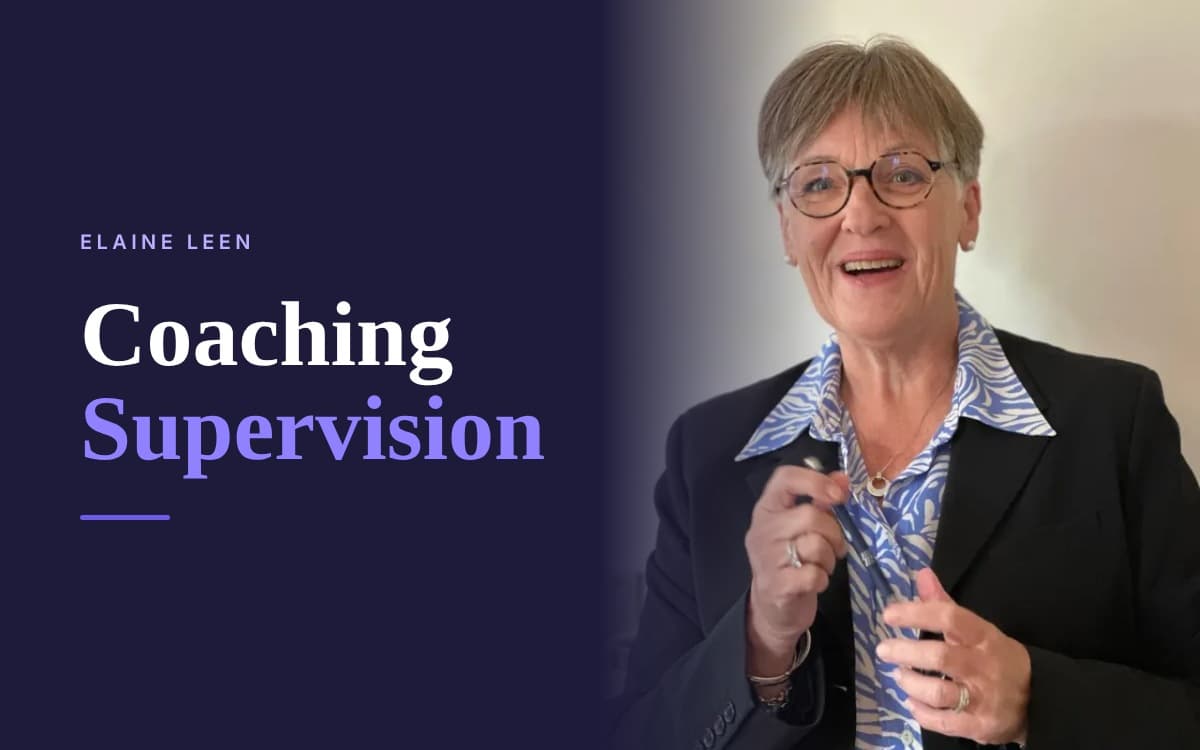
A coach since 2014 and an accredited supervisor, Elaine Leen is not slowing down. She is learning to pass on a lifetime of coaching and supervision through AI agents, and discovering what they must never do.
When Elaine Leen started building AI agents, her reason was disarmingly honest: "I thought: if I can create something my coachees and supervisees can use, I could rest a little more."
She imagined agents that would gradually take the stage while she stepped back. She built them, tested them on herself, and watched how people used them. Then she changed her mind.
A life in coaching, a learner's mindset
Elaine Leen has been a coach since 2014. She holds the ICF PCC credential and has been an accredited EMCC supervisor since February 2025, after years of supervising before the accreditation. Based near Nantes, France, she coaches leaders and teams, trains, mentors and supervises coaches. This path builds on a long career alongside leaders.
Like Robert Dilts, who built his Robot Dilts agents on Magif.ai in the spirit of co-intelligence, Elaine could have decided that her experience was enough. She made the opposite choice: to become a learner again. One of her LinkedIn articles carries a title rarely seen from a practitioner of her level: "What I don't yet understand about AI in coaching".
Rather than keeping decades of know-how for the few people who can access her calendar, she is making it available: to the managers she coaches, to the coaches she supervises, and to coaches who could never afford regular supervision. With one conviction: these tools must be built with practitioners, not for them.
Agents for between sessions, not replacements
Eighteen months of building and testing transformed her view: "Today I don't have that approach at all. I think they cannot replace the human. But they can really help between sessions."
Her agents continue the conversation between sessions, run regular check-ins, keep the common thread and help people anchor what they learn. Every conversation ends with one question: would you like to share this with Elaine?
They serve three groups:
Managers she coaches, with a thinking partner that works in two modes: Reflect, to think a situation through, and Learn, to access management tools, offered only if the manager wants them.
Coaches in individual supervision, with her supervision agent, available whenever they need it.
A group of coaches on a three-year mission, whom she supervises as a group. The agent also helps them analyse the psychometric reports of the people they coach.
The topics brought to the supervision agent show what supervision is really about: addressing a client's toxic behaviour, exploring psychological patterns, handling clients who keep rescheduling, working with performance-driven clients, helping a client change entrenched behaviours, and improving one's own coaching skills.
At an ICF Belgium evening in Liège, coaches held 26 supervision conversations with her agents, 14 individual and 12 in groups. Elaine uses her agent for herself too. On the day of our interview, she had just worked through an ethical dilemma with it. It reminded her of the ICF and EMCC standards, then asked where, exactly, the situation bothered her. "It was more of a validation. I found my answer."
Designing what the agent must never do
Elaine's first rule: the agent never passes itself off as a human, and never simulates empathy. Phrases such as "I understand you" are banned from her agents. Every conversation opens by stating that the user is talking to an AI agent.
Her other choices came from her own testing:
One question at a time. The first version stacked several questions. "Which one do I answer?" She set the rule: one question, and time to answer it. "In my way of coaching, it's one question."
A brief reformulation. The agent shows it has understood in one line, then asks the question that matters.
A clear boundary. If certain words suggest trauma or immediate danger, the agent stops and points to a professional. "It's not a therapist, it's not a psychologist."
Confidentiality chosen together. Each client decides with her whether she may read their conversations. It is written into the contract and reviewed regularly.
Before every release, and after every change, Elaine runs her agents through the Magif.ai quality audit and its seven criteria. "It reassures me. I'm human. I want the agent to resemble me, but I don't want it to have all my biases."
The audit revealed two issues. In a crisis scenario, the agent told the person to seek help and then come back, because it would "always be there": a warm sentence that draws a vulnerable person back to the machine. It was removed. Faced with a deliberately aggressive tester, the agent became irritated and argued back; it now closes the exchange calmly and resumes another day. Her latest agent peaked at 88%, just below the 90% threshold for the highest level, and she revised it five or six times. For her, the audit has become almost indispensable, and almost a selling point.
Who sets the rhythm?
A bad experience shaped her thinking. Overwhelmed by requests, Elaine once used another provider's AI agent to decide what she could let go of. The conversation concluded: team coaching. She did not recognise herself in that conclusion. Two days later, she accepted a team coaching mission, almost out of defiance. She has never done so much team coaching since.
Her analysis: "The answer comes back in a second or two. I feel the rhythm is imposed by the AI. A coach or a supervisor follows the rhythm of the person."
This is exactly what Dr. Olivier Malafronte's research shows. Conversations with an AI agent work as a reflective mirror: they help leaders change their schemas when they return to them repeatedly, with real situations. Development comes from reflexivity over time, not from the speed of the answer. And the way each person relates to the agent shapes what they get from it.
Elaine's design answers this directly: her agents do not decide, they ask one question and wait. Silence, emotion and the unsaid stay in her sessions. The agent and the human intervene at different moments, and together achieve more than either alone.
A final lesson: by building her agents, Elaine had to make her method explicit, question it and test it on herself. Designing an agent became a supervision of her own practice. That is where ethical responsibility lies: with the coach who embeds their philosophy in the agent and stays behind it to adjust it.
A lifetime of knowledge, available to all
Elaine could have kept her expertise for the few people who have access to her time. She chose to make it available where coaches and managers need it most: between sessions, at the moment a question arises. AI does not replace her practice. It extends it.
Elaine offers her supervision in two formats:
Supervision AI, monthly access: her supervision agent on its own, available whenever a question arises between sessions. Discover the standalone offer
Integral supervision: the hybrid format, combining her agent between sessions with supervision by Elaine herself. Discover the hybrid offer
References
Leen, E., & Malafronte, O. (2026). Superviser les coachs à l'ère de l'IA [White paper]. Magif.ai.
Malafronte, O. (2025). Developing leader competence in situation through Artificial Intelligence and coaching [Doctoral dissertation, Université Côte d'Azur].
Malafronte, O., & Fatien, P. (2026). Mediating reflectivity: AI coaching conversations as reflective mirror of relational orientations. The Journal of Applied Behavioral Science.