The pressure we are building into AI
Organizations are adding a new layer of pressure on their people. Not on purpose. By design.
AI is being wired into email, learning platforms and HR systems to spot who has not logged in, who has not finished a module, who has not completed a challenge. Then it sends reminders. The intention is good: reach everyone. The effect is not. People feel watched, measured and behind.
Humans do not develop this way. Tracked for productivity and performance, they comply, then they disengage, then they burn out.
A different future is possible. AI can support and develop human competencies, and help scale empowering cultures. But only if we design it to meet people where they are, so they can choose to develop themselves instead of being tracked. Coaching philosophy and principles show us how.
I hear the same question almost every week. In a recent meeting, the head of coaching culture of a large organization put it simply: "Our AI agent works well for those who use it. But many never come back. Could we connect it to our email system, so the AI reaches out to them?" It is a legitimate question. The answer depends on one choice: chase people, or meet them where they are.
The temptation of the pull
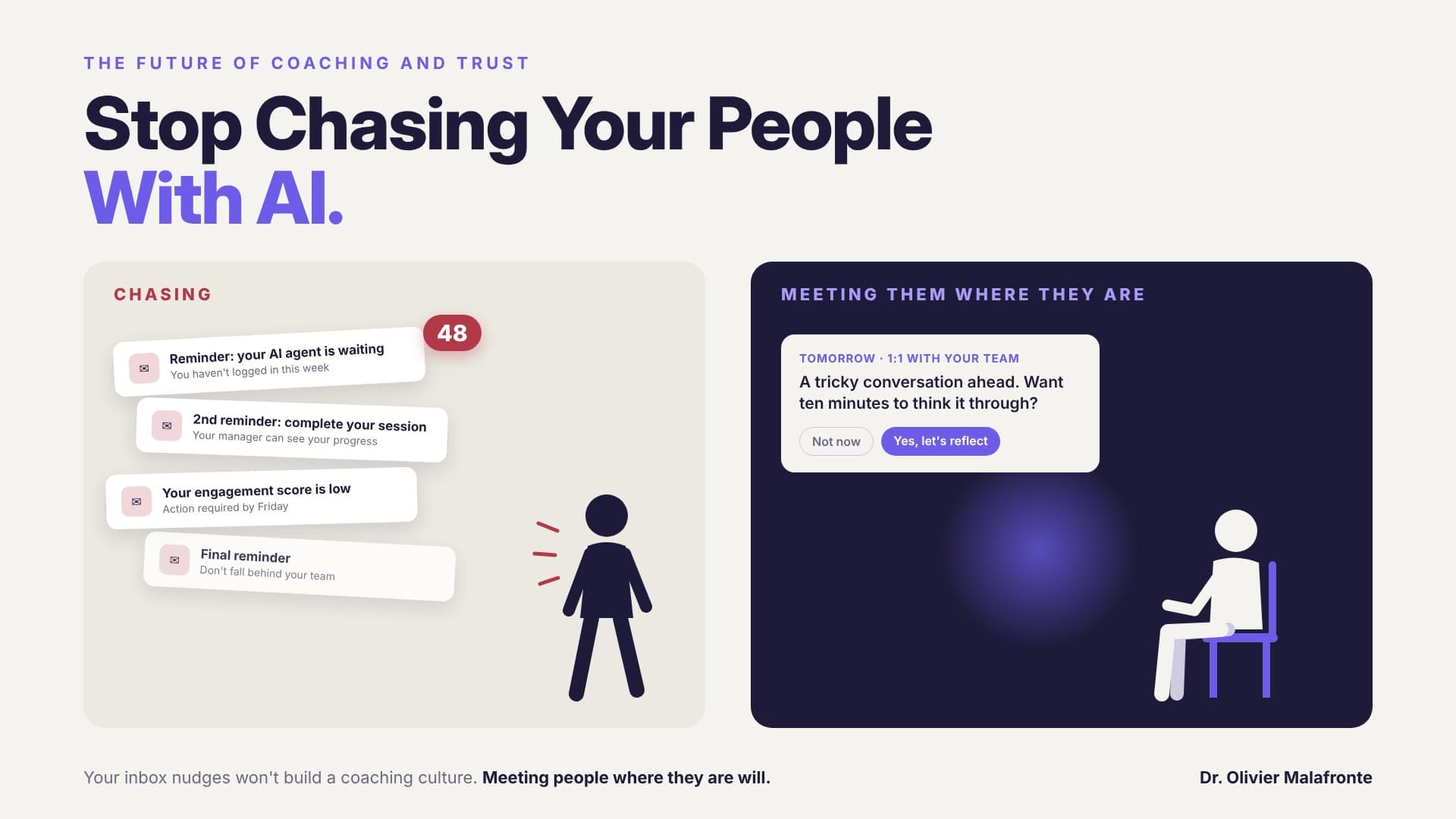
The technical path is easy. Connect the AI to email, calendar and HR systems. Detect who has gone quiet, who did not finish the leadership e-learning, who skipped the challenge the organization launched last month. Send a reminder. Then another. Track logins on a dashboard.
It feels like engagement. In coaching, it often produces the opposite.
Pressure replaces invitation. A message triggered by inactivity says "you are behind". Nobody reflects well under that signal.
Surveillance replaces trust. If the system knows who stopped, people assume it also knows what they said. They hold back.
Compliance replaces development. People open the tool to clear the notification, not to think. Usage goes up. Reflection does not.
The problem is not the technology. It is the logic behind it: treating people as a usage rate to optimize, rather than as adults to develop.
What the research tells us
My doctoral research analysed 176 conversations between mid level leaders and an AI coaching agent, across four countries (Malafronte, 2025; Malafronte & Fatien, 2026). Together with research on coaching in organizations and on algorithmic management, seven findings speak directly to this question.
1. The person, not the system, drives development. The leaders who grew the most were not the most solicited. They were the ones who took ownership of the process. One leader described it as choosing to "play the game of reflexivity". Another valued that the agent offered connections to human coaches, "if you want". That small phrase is the active ingredient: freedom.
2. The relationship starts before the first message. What people are told before they get access shapes how they engage. In an earlier study (Malafronte, 2024), participants who received no information about the purpose of the tool could not see where it was taking them, and asked to know the goal upfront. Informed leaders, by contrast, suspended judgment and gave the process time. Then the relationship takes one of two orientations. In instrumental conversations, leaders treat others, and the AI, as resources to control. In empowering conversations, they enter a real relationship and take responsibility for what happens (Malafronte & Fatien, 2026). Cunliffe (2016), drawing on Heidegger, contrasts calculative and meditative thinking. An AI that chases people, framed as a compliance tool, invites the calculative mode.
3. Trust is the condition of honesty. Leaders valued "exchanging with someone in complete confidentiality" and not being judged. They talk about their team, their manager, their company. They will only do so if they are sure the organization is not watching.
4. The organization is never a bystander. Kruger and Terblanche (2022) show that organizations shape the coaching relationship through four levers: how they facilitate coaching, who sets the agenda, how it is contracted and who selects the coach. When the organization took too much control, coachees held back and felt disempowered. An AI wired into HR and learning systems puts the organization at the centre of every one of those levers.
5. Algorithms can emancipate or oppress. Kane, Young, Majchrzak and Ransbotham (2020) show that machine learning systems can drift toward an oppressive future, when they are built to monitor and steer people, or toward an emancipatory one, when they are designed to expand people's own choices. Chasing employees through their inbox is a design choice on that line.
6. Development comes from return, and return is voluntary. Change happens through repeated reflection over time. People come back when the encounter was useful to them, not when they are reminded. No trust, no return. No return, no development.
7. Proactive AI is not the problem. Its trigger is. Terblanche (2026) distinguishes AI-supported coaching, where the person asks for help, from AI-led coaching, where the system uses calendars, goals or past conversations to anticipate a need and start the conversation. AI-led coaching can reach people at the right moment. It can also feel like monitoring: algorithmic surveillance lowers people's sense of autonomy and increases resistance, especially when it feels like evaluation rather than development (Schlund & Zitek, 2024, cited in Terblanche, 2026). His conclusion echoes the coaching view. Who initiates matters less than what the coaching serves. Participation, reflection and autonomy produce different organizational effects than performance, compliance and control.
Chasing people vs meeting them
The same connected systems can serve either logic. The difference is in the design.
| Chasing people | Meeting them where they are |
|---|
Who initiates | The system, driven by the organization's metrics | The person, or the system driven by the person's moments and needs |
Trigger | Inactivity, unfinished training modules, uncompleted challenges | Moments that already matter: a new role, a first team meeting, a feedback conversation, a reorganization |
Message | "You haven't used the tool this week" | "You have a difficult 1:1 tomorrow. Want ten minutes to prepare?" |
Tone | Reminder, obligation | Invitation, with an easy way out |
Data | Individual usage reported to managers | Conversations owned by the person; only anonymized patterns shared |
Designer | IT and HR systems | A human coach who embeds a coaching philosophy |
Success measure | Logins and completion rates | Clarity, confidence, actions taken, voluntary return |
What grows | Compliance | Reflection, and a coaching culture |
Five principles for a coaching-designed AI encounter
Start from the moment, not the metric. Map the moments where people genuinely need to think: before a hard conversation, after a change announcement, at the start of a new responsibility. The AI shows up there, in the channels people already use.
Invite, never chase. Every message is an offer, short and easy to decline. Silence is respected. A person who says no today may say yes next month, precisely because they were not pushed.
Make the coach accountable for the design. The ethics of AI in coaching do not sit in the technology. They sit with the coach who embeds their philosophy into the agent, including how and when it approaches people.
Let data serve the person first, then the culture. Conversations belong to the individual. Aggregated, anonymized patterns can show the organization which topics and moments matter most. That is how data builds a coaching culture without becoming surveillance.
Let the agent work autonomously, with the right intention. A human coach does not need to sit in every loop. What matters is the intention built into the agent: meeting the person, respecting their motivation, serving their development. Designed this way, the agent can run on its own and stay deeply human, because the ethics travel inside the design. And when someone wants more, the door to a human coach stays open.
Changing the question
The organization's first question is usually: "How do we get people to use it?"
A better question is: "Which conversations do our people need, and when?"
Ask the second one, and engagement stops being a target. It becomes a consequence. The original problem gets solved, people come back, and nobody feels pushed.
A humanist vision of AI in management
Fewer than 1% of people at work have ever had access to coaching. AI can change that. But only if it carries the spirit of coaching with it, not the logic of a marketing funnel.
Meeting people where they are is one of the oldest principles of our profession. It does not become obsolete with AI. It becomes a design requirement.
Terblanche (2026) describes how AI coaching can scale the coaching ripple effect: small conversations, repeated across many people, gradually reshape routines and norms. That is how an empowering culture can grow. It also carries a risk. One system used by everyone can make everyone think alike. Agents designed by coaches with different philosophies, which leave people free to choose, protect that diversity of judgment.
AI does not transform organizations. Reflection does. AI makes reflection scalable, as long as it respects the freedom, the pace and the dignity of each person.
Your turn
If your AI agent sent one message to your people tomorrow, would it feel like a reminder, or like an invitation?
References
Cunliffe, A. L. (2016). On becoming a critically reflexive practitioner (republication). Journal of Management Education, 40(6), 740-746.
Heidegger, M. (1966). Discourse on Thinking. Harper & Row.
Kane, G., Young, A., Majchrzak, A., & Ransbotham, S. (2020). Avoiding an oppressive future of machine learning: A design theory for emancipatory assistants. MIS Quarterly, 45, 371-396.
Kruger, F., & Terblanche, N. H. D. (2022). Working alliance theory in workplace coaching: A pilot study exploring the missing role of the organization. The Journal of Applied Behavioral Science. https://doi.org/10.1177/00218863221136125
Malafronte, O. (2024). Développement des leaders avec coaching et intelligence artificielle : augmentation des compétences. Management & Avenir, 142(4), 39-59.
Malafronte, O. (2025). AI Coaching and Leadership Competence Development [Doctoral thesis]. Université Côte d'Azur, IAE Nice Graduate School of Management.
Malafronte, O., & Fatien, P. (2026). Mediating reflectivity: AI coaching conversations as reflective mirror of relational orientations. The Journal of Applied Behavioral Science.
Schlund, R. J., & Zitek, E. M. (2024). Algorithmic versus human surveillance leads to lower perceptions of autonomy and increased resistance. Communications Psychology, 2(1).
Terblanche, N. (2026). When AI coaching becomes a change agent: From micro interventions to emergent organizational change. The Journal of Applied Behavioral Science. https://doi.org/10.1177/00218863261488991