AI That Makes Room to Feel: What My PhD Research Reveals About AI Coaching and the Return to Self
During my doctoral fieldwork, I read a piece of feedback that stopped me. A mid-level leader, describing what had happened during a conversation with one of my AI coaching agents, wrote that they had cried. Not from distress. From relief. They had been carrying a fear for months, managing it quietly, never quite saying it out loud to anyone. Mid-conversation with a machine, they let it go.
I've since shared that story publicly, and it tends to provoke one of two reactions. Some people find it moving. Others find it unsettling, even a little wrong. How can a person feel more met by an algorithm than by another human being? Doesn't that say something troubling about where we're headed?
I want to take the time here to answer that question properly, because the honest answer isn't "AI is replacing human connection." It's more hopeful than you think. My research suggests AI coaching doesn't compete with human connection at all. It creates a different kind of space, one that can restore a connection many leaders had quietly lost: the connection to themselves.
A sacred assumption, and a counterintuitive finding
Coaching, as a field, holds one belief close to sacred: the relationship is everything. The working alliance between coach and client is treated, understandably, as the vehicle through which change happens. So when a machine with no face, no history, and no emotional reaction of its own enters that equation, the assumption is that something essential must be missing.
My doctoral research, built on interviews and AI coaching conversation analysis with 190 participants between leaders, aspiring leaders, and three AI coaches, gathered over several years of fieldwork, complicates that assumption. Across my case studies, participants' feedback and interactions surface that the absence of another person's emotional reaction wasn't experienced as a void. For a meaningful number of participants, it was experienced as safety.
One leader put it plainly: in front of an AI, they could "speak about emotion without the emotional background of the other person." No reaction to manage. No face to read. Another described it more simply still: "not having a human being judging me along the way was very pleasant." A third recalled the exercise of reflecting out loud, unfiltered, as something they rarely allowed themselves to do, precisely because there was usually someone on the other end of it.
None of this is a small, cute anecdote. It's a pattern that shows up across case after case, and it points to something coaching research has under-examined: sometimes what people need isn't more relational attunement. It's less social performance.
Why the absence of a person can be a gift, not a gap
There's a concept from the coaching literature worth naming here: emotional neutrality. It's usually framed as a limitation of AI coaching, something that could, in theory, "hinder more profound affective development" because it lacks reciprocity. That critique is fair, and I address it directly in my thesis as a genuine boundary condition of this work. Emotional neutrality is, in a real sense, a double-edged sword.
But a sword that cuts both ways still cuts. And what my data shows is that the same neutrality that can flatten a relationship can also lower the social risk of being honest. Most of us manage our emotional disclosures according to who is in the room. We read faces. We calibrate how much to say based on how the other person might react, whether they'll judge us, worry about us, or simply not know what to do with what we've told them. That calibration is so automatic we rarely notice we're doing it.
Remove the other person's emotional reaction from the equation, and something shifts. Several leaders in my study described a kind of relief in being able to think out loud without having to simultaneously manage someone else's response to their thinking. One leader described it as a form of rationalization that became possible precisely because the emotional charge on the other side of the conversation was absent: it let them qualify their own emotion, assess its intensity, and work with it, rather than being swept along by a shared emotional current.
This is not a case for replacing coaches. It's a case for recognizing that different conditions unlock different kinds of honesty. Sometimes the presence of another person, however well-intentioned, is a gap. And sometimes its absence is a gift.
From performing to feeling
One of the clearest patterns in my research is what I call a shift in affective schema, the emotional frame someone brings to a challenge before and after a reflective conversation. At the start of these AI coaching conversations, leaders tend to frame their situations in terms of individual deficit. They describe themselves as anxious, frustrated, tired, not legitimate enough, not clear enough, not certain enough. The responsibility, and the blame, sits squarely on their own shoulders.
By the end of the same conversation, something has moved. Leaders report feeling reassured, more settled, clearer about a path forward. Several use the exact word: relief. Not because a problem has been solved for them, but because they've been able to sit with it long enough, honestly enough, to see it differently.
I distinguish in my findings between two forms of this movement. In what I call instrumental conversations, people use the tool, and even the idea of reflection itself, to serve a fairly narrow, self-centered goal: reassurance, efficiency, getting unstuck. But in what I call empowering conversations, something else happens. People stop treating the exchange as a transaction and start treating it as a genuine space for reflection. They describe the AI coach less as an object to extract value from and more, in their own words, as "playing the game" of reflexivity with it. One participant said the sequence of questions "leads to reflect on one's own situations. It is not intrusive but rather helps guide the thought process." Another remarked that the tool's limits "seem to come more from the user than from the avatar's script."
That distinction matters enormously, because it locates the outcome where it actually belongs: not in the machine's cleverness, but in the person's willingness to engage honestly with themselves. The AI coach, at its best, isn't performing empathy. It's holding a structure, opening affect, present situation, desired outcome, resources, action, closing affect, stable enough that a person can finally stop performing for someone else and start feeling what's actually there.
Not a replacement. An opening.
It would be easy to read all this as an argument that machines make better confidants than humans. That's not my claim, and it's worth being precise about why.
Critics of workplace AI have rightly raised concerns about dehumanization, about technology flattening people into information to be processed rather than humans to be understood. I take that critique seriously in my work. But what I found empirically points somewhere more specific: AI coaching's real potential isn't in replacing the interpersonal, it's in facilitating something intrapersonal first. Self-reflection. The kind of unguarded audit of your own thinking that's hard to do when you're also managing someone else's presence.
And critically, that self-reflection doesn't stay self-contained. In my findings, leaders who moved into what I've called empowering conversations didn't turn inward and stay there. They moved outward again, toward their teams, their stakeholders, their organizations, but with more clarity about what they actually needed to say and do. Several described wanting to bring others into the solution once they'd worked through their own relationship to the problem: convening a team meeting, having a harder conversation with a stakeholder, changing how they delegated. The self-reflection was the on-ramp, not the destination.
This is why I resist "AI coaching is replacing human connection" as a framing entirely. What I observed looks more like sequencing: a private space to feel something honestly, followed by a renewed capacity to connect with others authentically. You could argue that's what good human coaching does too, and you'd be right. The difference is that for some people, in some moments, a machine without a face turned out to be the thing that made the first step possible.
What this means if you work with people
If you're a coach, a facilitator, or anyone building AI coaching tools, I don't think the lesson here is "add more empathy simulation" or "make the AI feel more human." My data suggests almost the opposite instinct is worth protecting: the value in this modality may lie precisely in what it doesn't do, rather than in how convincingly it imitates what a human would.
The practical implication is to design and facilitate for the conditions that let people be honest with themselves first: low judgment, low performance pressure, a structure that holds without steering. Whether that structure is delivered by a human coach or an AI agent may matter less than whether it's present at all.
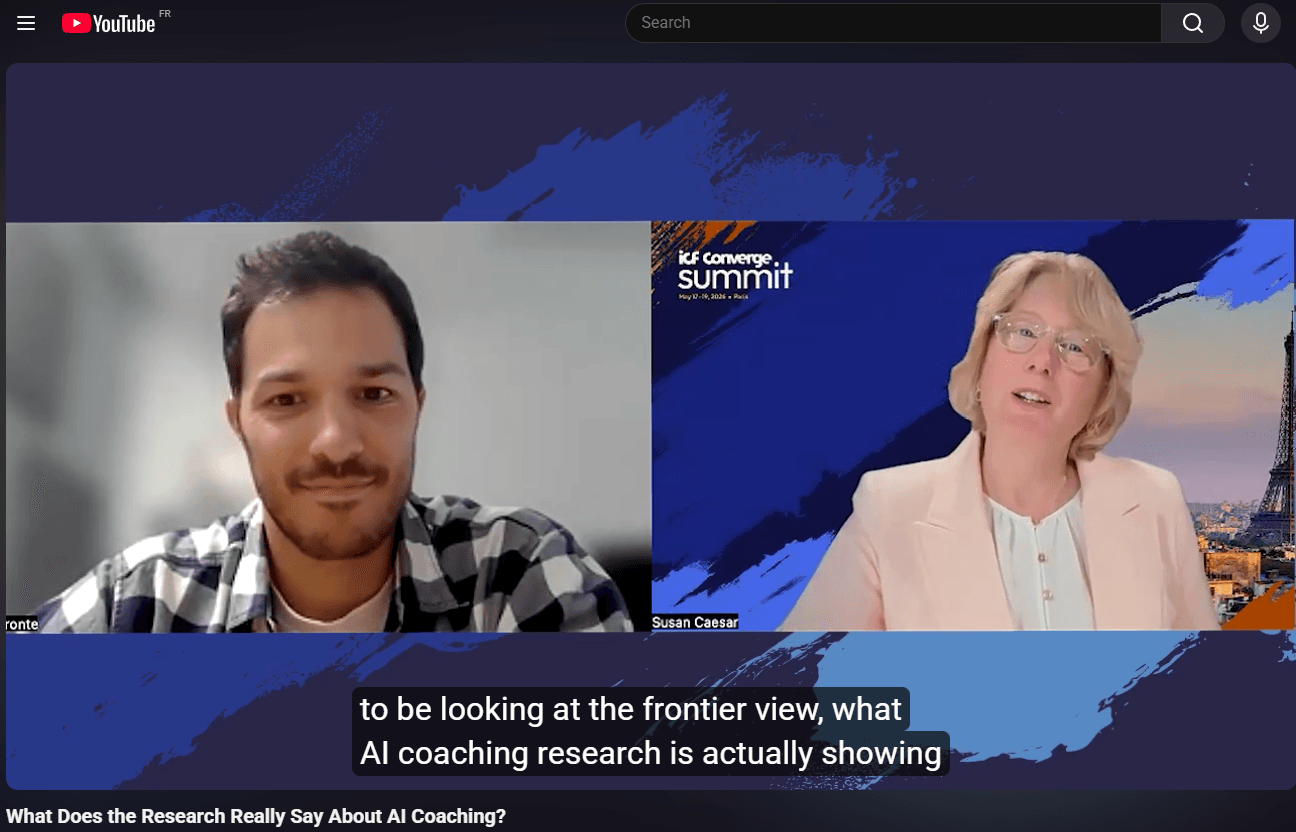
I'll be unpacking more of these findings, and the "magic isn't mystery, it's engineered conditions" idea I've written about elsewhere, in conversation with Susan Caesar, ICF Global's AI Director, recorded at the ICF Converge Summit 2026 in Paris. I'll share that conversation alongside this piece. If this resonated, I'd genuinely like to hear where you land on it, especially if you disagree. That tension is exactly where the interesting research questions live next.
Blog post written by Olivier Malafronte, PhD, Executive Coach, cofounder at Magif.ai, associated research and HR teacher at GRM Lab, Université Côte d'Azur, IAE Nice Graduate School of Management, co-author of ICF Global AI Coaching Standard, member of the Coaching Coalition and ICF AI Ethics advisory board.