In June 2025, Magif.ai co-founder Dr. Olivier Malafronte defended a prize-awarded doctoral thesis at Université Côte d'Azur on how Artificial Intelligence and coaching together develop leader competence in the flow of work. The thesis closed a chapter that began in 2015, when Olivier first started experimenting with AI in coaching practice, years before "AI coaching" existed as a recognized category.
Since then, Olivier has spent as much time sharing the research as he spent producing it, not only in academic journals, but in rooms and video calls with coaches, chapter leaders, and practitioners across the ICF and EMCC communities, on nearly every continent. This post brings both threads together: what the research actually found, and where Olivier has taken it since.
What the research found
The thesis, Developing leader competence in real-world situations through Artificial Intelligence Coaching, is built on a grounded theory approach spanning four data collection phases between 2018 and 2024, drawing on conversations and feedback from near 190 leaders and aspiring leaders working with three AI coaches. It is the first research design of its kind to explore, empirically, what actually happens inside AI coaching conversations — and how that shapes leader development.
Six contributions came out of the work:
AI can replicate coaching conversations. AI coaching enables the same cognitive and affective regulation mechanisms found in human coaching — and repeated over time, these mechanisms develop leader competence directly from real work situations.
Leaders relate to AI in two distinct ways. Some approach it instrumentally, others with an empowering orientation. When an AI coach can surface which orientation is in play, that distinction becomes a reflective moment in itself — the core finding of Olivier's 2026 paper with Pauline Fatien in the Journal of Applied Behavioral Science.
AI coaching measurably augments leader skills — empathy, work organization, communication, and confidence, specifically.
AI coaching isn't a substitute for human coaching — it's a different category. It reproduces some outcomes human coaching produces, and generates others that human coaching does not. That distinction matters for how organizations should deploy it.
It scales what was previously scarce. Coaching conversations become accessible to far more people than the few who get access to a human coach.
AI coaching tools are a new source of research data — a methodological contribution, since they let researchers observe competence development as it happens, inside real managerial situations, rather than reconstructing it after the fact.
The research is published in Management & Avenir (2024), the Journal of Applied Behavioral Science (2026), and a forthcoming Springer chapter in Coaching in the Age of AI (Wegener et al., Eds.). It has been presented at AGRH, the European Academy of Management, the Africa Academy of Management, the Academy of Management, and the AMBA & BGA Annual Conference in Berlin and Madrid — built on research collaborations with the University of Surrey (UK) and the Gordon Institute of Business Science (South Africa). Olivier also co-authored the ICF Global AI Coaching Standards, which draw directly on these findings.
The throughline across all of it: AI does not replace the human work of coaching — it makes reflection scalable. That principle is what Magif.ai was built around, and it is the same argument Olivier has been taking to coaching communities around the world this past year.
Taking it to ICF chapters worldwide
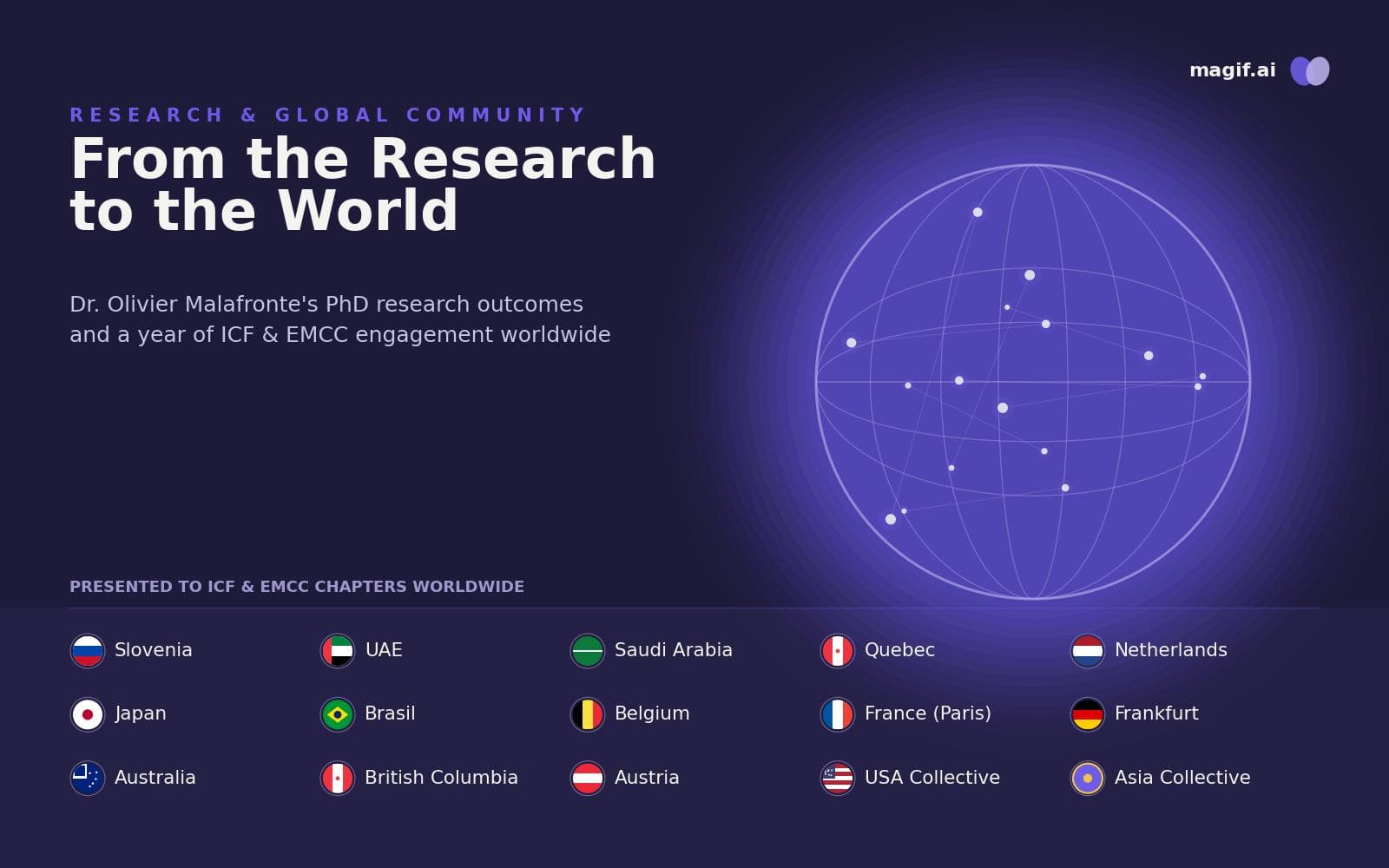
Since completing the thesis, Olivier has presented these findings to ICF chapters on nearly every continent — always the same core question, adapted to each community: what does the evidence actually say about AI in coaching, and what does that mean for how coaches practice?
And the community keeps growing
Olivier will soon speak in five new chapters joining the conversation:
Frankfurt Chapter
British Columbia Chapter
Austrian Chapter
More on each of these sessions soon.
Beyond ICF: EMCC and a new Asian collective
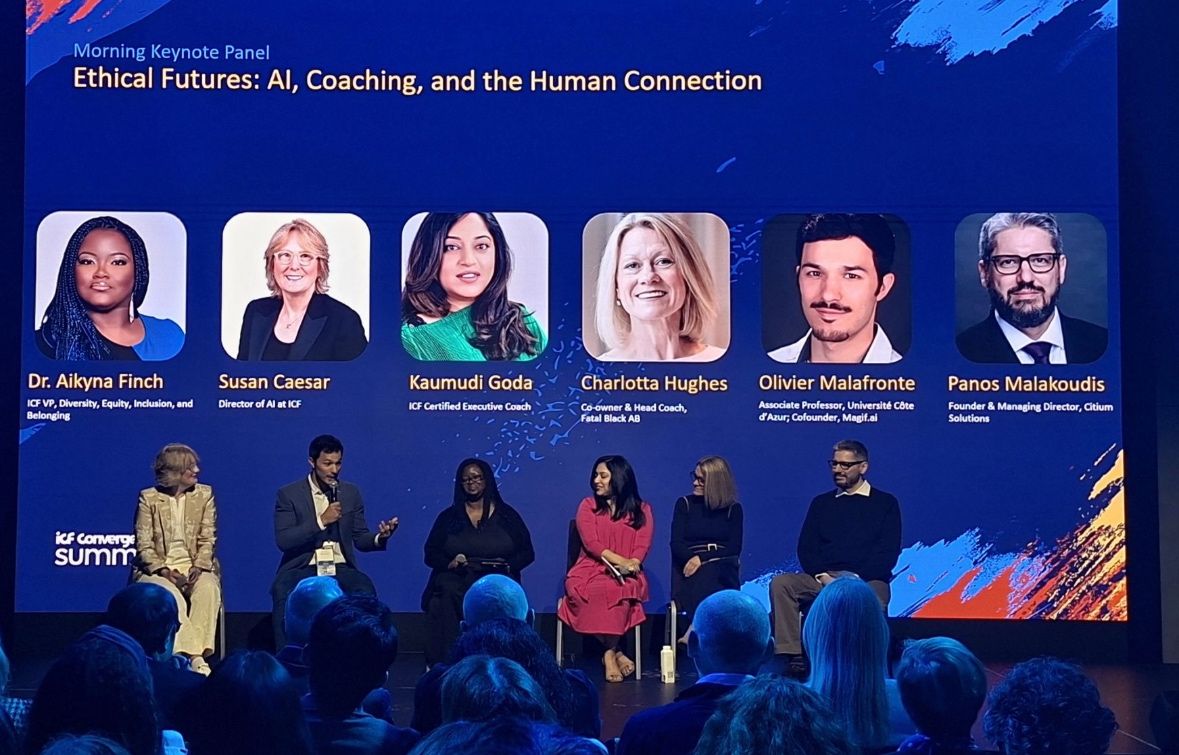
Olivier's engagement is not ICF-exclusive. As part of the AI Coaching Coalition Europe, working alongside ICF, EMCC, and AC, he has also brought this research directly to EMCC audiences — most recently in a session on AI and coaching (link).
And next up: a new engagement with the EMCC Asian collective end of 2026.
Beyond ICF & EMCC: Coaching organizations
Through the dissemination of his AI coaching expertise, Dr Olivier Malafronte supports various organizations and transformation organizations such as Gofore in Helsinki or CoachSource during the annual event in New Orleans, on October 13-14.
Why this matters
Every one of these conversations sharpens the same point: AI coaching is not a shortcut around human development — it is a way to make the deep, reflective work of coaching reach more people, more often, in the actual flow of their work. That is what the data showed across 146 leaders' conversations, and it is what Olivier keeps hearing echoed back, chapter after chapter, in language after language.
If you lead an ICF, EMCC, or AC chapter and want this research in your community, or if you are a coach curious about what the evidence actually says before forming a view on AI in your practice, get in touch with Olivier, he would be very happy to share all he knows to the community, free of charge.