Ask any coach what makes coaching work, and most will say some version of the same thing: the relationship, the alliance. That felt sense of trust and rapport between coach and client, built session by session, that supposedly carries the whole enterprise.
I don't dispute that the relationship matters. It does, for sure. We agree on this right from this line. But my research insights force us to ask a less comfortable follow-up question: matters for what, exactly, and for how long? Because when we look closely at what the working alliance actually does over the course of a coaching engagement, and then built a study comparing AI-based coaching conversations directly against human-based ones, the picture that emerged was more complicated than "the relationship is everything."
The alliance is real. It's also front-loaded.
The coaching literature already tells us something coaches don't love repeating out loud: the working alliance is mostly formed, and mostly significant, at the beginning of a coaching relationship (de Haan et al., 2020; Kruger & Terblanche, 2022). Its effect on outcomes doesn't hold steady across a coaching engagement. It concentrates early and tapers.
That single finding reframes a lot of what coaching assumes about itself. If the relationship's explanatory power is strongest in session one or two, then whatever is producing change in session eight probably isn't the same thing that got the client to open up in session one. Something else has to be doing the work later in the process. My research points to what that something else looks like: behavior, structure, and the quality of the questions being asked, not the warmth of the bond alone.
Gessnitzer and Kauffeld (2015) put this bluntly in the title of their own study on the coaching relationship: "The working alliance in coaching: why behavior is the key." Not affinity. Not chemistry. Behavior. What the coach actually does in the room, moment to moment, turns out to matter more than how likeable they are.
What happens when you take the human out and watch what's left
I wanted to explore this more directly, so one of my thesis articles is a deep qualitative comparative study of AI-based coaching conversations (AIBCC) against human-based coaching conversations (HBCC). If relationship warmth alone explained coaching's outcomes, AI coaching, which offers none of it, should have revealed it noticeably. It didn't.
Both AIBCC and HBCC moved executives through the same underlying mechanism: an initial shift in cognitive schemas (what they were paying attention to: organizing work, communicating with others, managing their emotions in the moment) and a shift in affective schemas (moving from a negative emotional read on their situation to a more positive one). Both approaches guided executives toward action. Both produced learning, primarily about self-regulation, that executives could name and use afterward.
Where the two diverged is instructive. AI-based conversations reached similar outcomes in about 15 minutes, compared to 30 to 60 minutes for human-based sessions. Human coaches, even skilled ones, showed a measurable pattern of talking over their clients, interrupting, and folding their own thoughts into the client's reflection, something the AI coach structurally couldn't do because it doesn't have opinions of its own to insert. That difference in discipline showed up directly in the data: AI-based conversations produced more stable, more linear affective progress, while human-based conversations showed more back-and-forth, more volatility, between positive and negative states.
One verbatim from the study makes the point better than any statistic. A client, reflecting on a human coaching session that had actually gone well, said: "You actually, you didn't talk that much, but the few questions you asked actually made me dig a little deeper into my responses." The value wasn't the coach's presence. It was the coaching behavior, the coaching skill, the coaching space, and the client's choice to be engaging in, or also forming, that type of AI coaching relationship; an empowering relationship (like explained in this peer-reviewed ranked research journal from Malafronte & Fatien, 2026).
So does the relationship matter, or not?
Here's where I want to resist the temptation to overcorrect, because the honest answer isn't "relationship is irrelevant." My own comparative findings show real, specific things human coaches still bring that AI coaching, at least as I studied it, didn't fully replicate: human experience and warmth, and a greater capacity for in-depth probing and engagement when a coach is skilled enough to use it well. Those aren't small. For some clients, in some moments, that human presence is precisely what unlocks the work.
What the data does undercut is the assumption that warmth is sufficient on its own, and that it's the primary driver of results across an entire coaching engagement rather than a front-loaded ingredient that gets a client to the table. My earlier research into AI coaching conversations found something that reinforces this: leaders who could speak "without the emotional background of the other person" often went deeper into difficult material precisely because there was no relationship to manage. Relationship and depth aren't always the same lever, and sometimes they pull against each other.
This is also why the question "would you keep paying a coach just for the relationship?" isn't just provocative rhetoric. It points at something structural in how coaching gets bought. Buyers of coaching, and this includes HR teams and sponsoring organizations who are frequently not the person sitting in the room, are paying for outcomes: behavior change, clearer decisions, better-managed teams. A pleasant hour is not, by itself, a line item that survives a budget review. If the relationship isn't reliably translating into outcomes past the first few sessions, that's a real problem for how coaching justifies its value, independent of any AI angle at all.
The uncomfortable, useful reframe
What I'd ask coaches to sit with isn't "AI is coming for your job." It's a more useful and more answerable question: if you removed your warmth from the equation and just looked at your behavior, the specific things you do and don't say, the discipline of your questions, the restraint you show, would your outcomes hold up?
My research suggests that for the coaches whose value really is behavioral (precise questioning, genuine restraint, structured reflection) the answer is yes, and AI coaching tools are unlikely to replace what they do, because that behavior is exactly what's hard to automate well. For coaches whose value has quietly become mostly relational, pleasant conversation, felt support, minus the behavioral discipline underneath it, this is a genuinely harder question.
None of this makes the relationship meaningless. It makes it one ingredient among several, front-loaded, real, but not sufficient by itself to explain why coaching works when it works. Naming that precisely, rather than defending the relationship as sacred, is what lets the field actually improve.
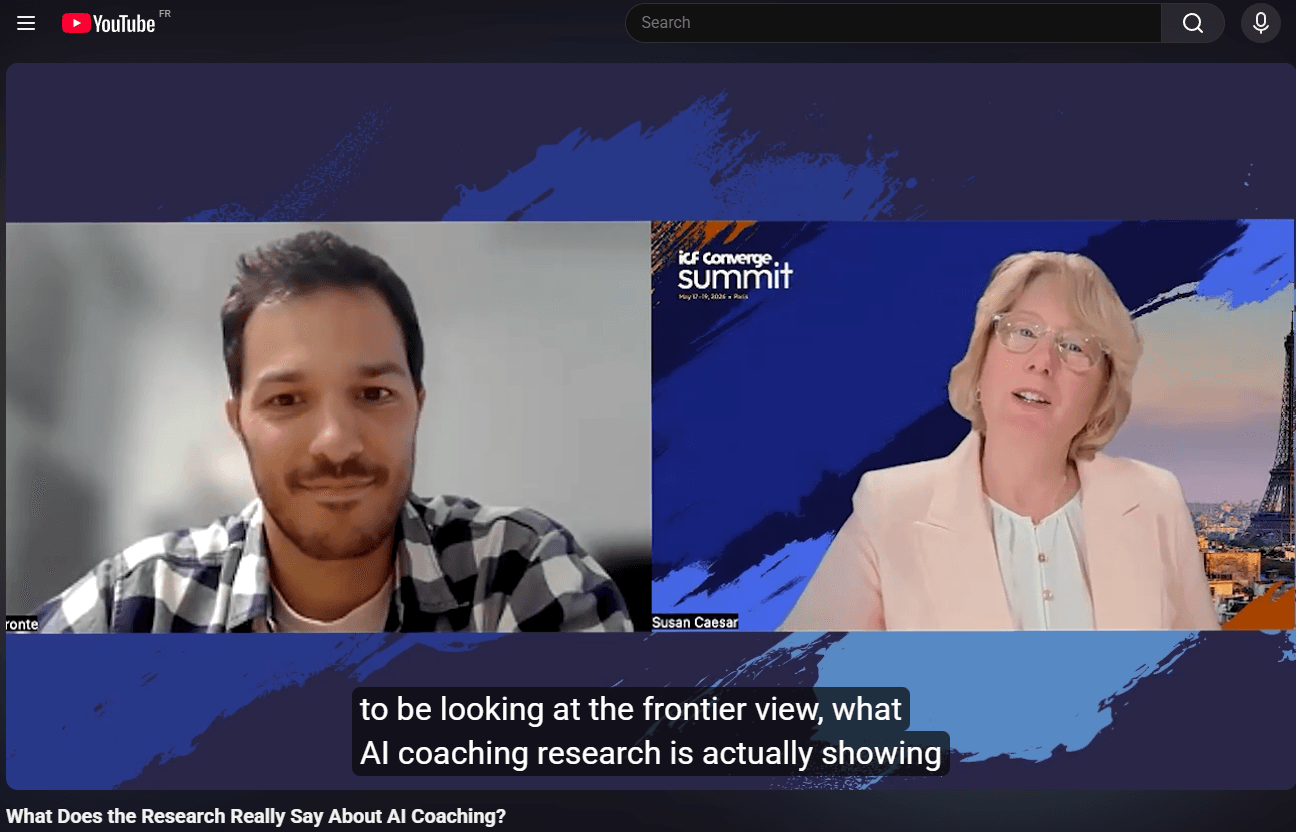
I unpack this alongside the "magic is engineered conditions" argument from earlier in this series in conversation with Susan Caesar, ICF Global's AI Director, recorded at the ICF Converge Summit 2026 in Paris. I'll share that conversation alongside this piece. If you're a coach and this challenged something, I'd rather hear the pushback than the agreement, that's usually where the better argument is hiding.
References:
de Haan, E., Molyn, J., & Nilsson, V. O. (2020). New findings on the effectiveness of the coaching relationship: Time to think differently about active ingredients? Consulting Psychology Journal: Practice and Research, 72(3), 155–167. https://doi.org/10.1037/cpb0000175
Gessnitzer, S., & Kauffeld, S. (2015). The working alliance in coaching: Why behavior is the key to success. The Journal of Applied Behavioral Science, 51(2), 177–197. https://doi.org/10.1177/0021886315576407
Kruger, F., & Terblanche, N. H. D. (2022). Working alliance theory in workplace coaching: A pilot study exploring the missing role of the organization. The Journal of Applied Behavioral Science, 60(2), 310–332. https://doi.org/10.1177/00218863221136125
Malafronte, O., & Fatien, P. (2026). Mediating Reflectivity: AI Coaching Conversations as Reflective Mirror of Relational Orientations. The Journal of Applied Behavioral Science, 00218863261453415. https://doi.org/10.1177/00218863261453415