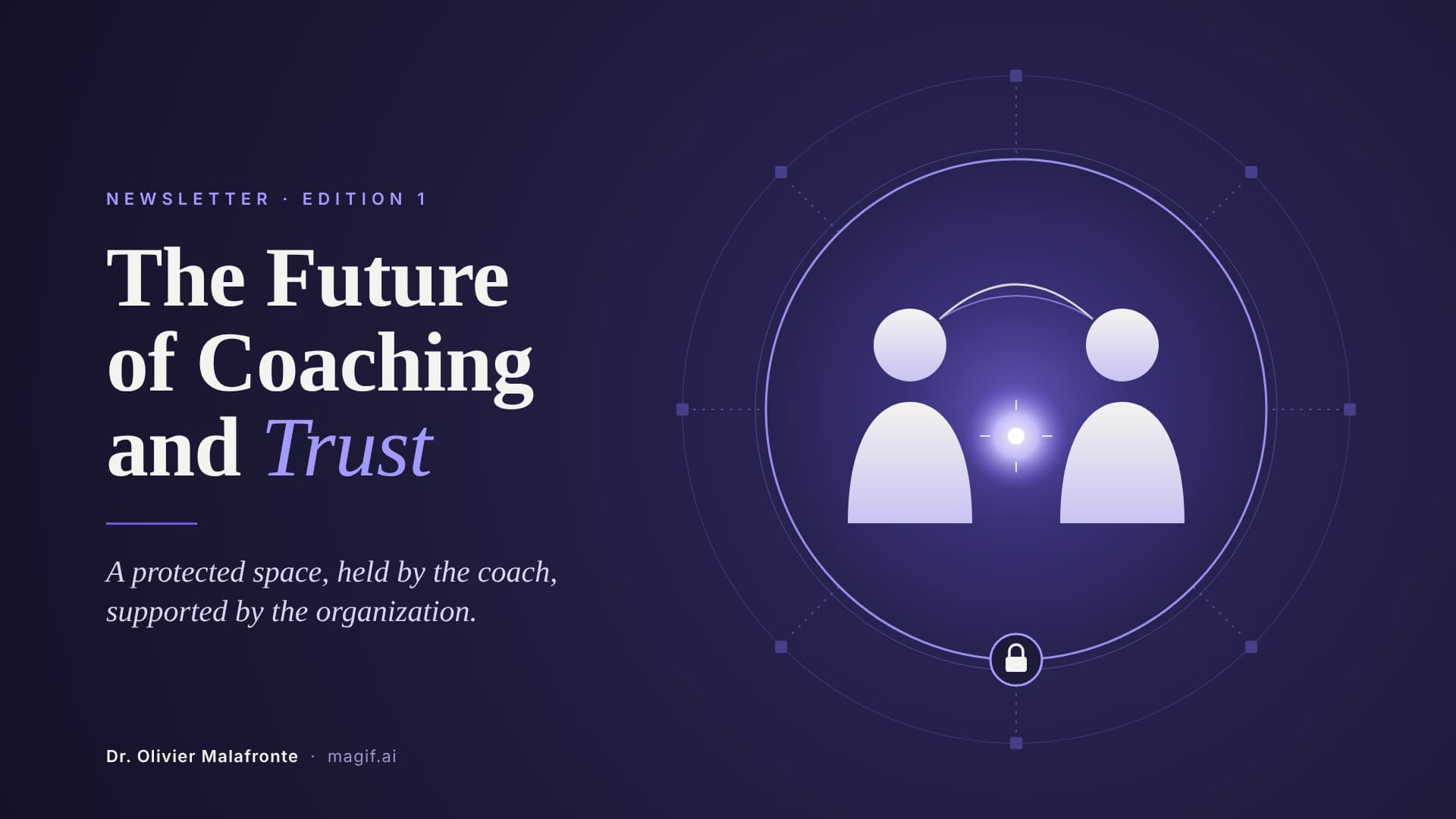
Why controlling the data might be the fastest way to lose it
"How do I know that what's being shared is not going to be shared back with the company?"
A coachee said this in a study on workplace coaching. She was talking about her human coach, one chosen for her by her organization.
Today, the same question is being asked about AI.
The shift
As AI enters everyday work, many organizations want to build their own internal AI tools, often on top of well-known commercial models, hosted and monitored in-house. For coaching, the reasoning seems sound: our data, our infrastructure, our control.
But research on coaching, including my own, tells a different story. And it's worth listening to before we rebuild the same mistakes at scale.
What the research on human coaching tells us
Kruger and Terblanche (2022) interviewed 14 coachees, six with positive coaching experiences and eight with negative ones, to explore an overlooked question: how does the organization influence the relationship between coach and coachee?
Their answer: the organization is never a bystander. It shapes the three pillars of the coaching relationship (goals, tasks and bond) through four levers: how it facilitates coaching, who sets the agenda, how coaching is contracted, and who selects the coach.
The most striking findings concern trust. When contracting was unclear, or when the organization picked the coach without the coachee's input, people held back. One said she was wary of sharing too much, wondering what would get "reported back to the organization." In some cases, assigned coaches were friends of the coachee's own superiors, and the safe space disappeared entirely. When the organization took full control of coach selection, coachees felt disempowered, even manipulated, and the bond broke down.
The authors also point to earlier research showing that guaranteed confidentiality was rated the single most important success factor in executive coaching, by coaches, coachees and organizations alike.
What my research on AI coaching adds
Over the past years, my doctoral research has studied AI coaching conversations with leaders in three international organizations. Three findings matter directly here.
1. AI coaching conversations are never only about the individual.
Leaders don't just reflect on themselves in AI coaching conversations. They socialize their issues: they bring in their team, their manager, their peers, the wider organization (Malafronte & Fatien, 2026). An AI coaching log is therefore not a record of one person's thoughts. It holds their perceptions of their boss, their colleagues and their company. Imagine what happens to candour the moment people suspect that record is visible to the organization.
2. Development requires repeated use, and repeated use requires trust.
Our work shows that leader competence develops through repeated, deliberate engagement over time, not through a single conversation (Malafronte & Loufrani, 2025). Adoption is not a vanity metric. It is the mechanism of development itself. If people don't trust the space enough to come back, the AI coach cannot work, however good the model is.
3. AI augments; it doesn't replace.
AI coaching contributes by amplifying leaders' own capabilities through structured reflection, not by delivering expertise (Malafronte, 2024). It enables leaders to self-supervise in the flow of work, as long as the coaching design and supervision remain human (Malafronte, 2026). AI doesn't transform organizations. Reflection does. AI makes reflection scalable.
In my own field studies, confidentiality wasn't an afterthought. It was a precondition, addressed explicitly with participants and top management before any leader opened the AI coach.
The paradox, applied to AI
Now picture an internal AI coaching tool where the organization owns the model, stores the conversations and can access every log.
That is not just the organization choosing the coach. It is the organization sitting in the room, listening to what leaders think about their team, their manager and the company itself.
The research is clear about what happens next: people self-censor, the bond weakens, they stop coming back, and development quietly stops. In AI terms: low trust, low adoption, low impact, regardless of how good the technology is.
Enabler, not observer
This doesn't mean organizations should step back. Kruger and Terblanche show the opposite: coaching works better when the organization actively supports it: positioning it as an opportunity, clarifying its purpose, creating time for it, and contracting it transparently.
The organization's role is essential. It's just a different role: enabler of trust, not observer of conversations.
From three parties to four
Workplace coaching has always been a three-party relationship: coach, coachee and organization. Kruger and Terblanche even propose extending how we measure the coaching relationship to include the organization explicitly.
With AI, a fourth party joins the system. And the critical question becomes: who does the AI answer to?
In a trust-centred model, the answer is clear:
• The coach designs the agent, embeds their methodology and ethics in it, and supervises it over time. AI never replaces the coach. It extends the coach.
• The employee owns their data and decides what is shared.
• The organization sponsors, supports and receives aggregated insights, never raw conversations.
• The AI supports reflection before, between and after coaching sessions, and offers a coach-designed, coach-supervised space for people who can't access a coach, when time or budget make human coaching hard for organizations to provide.
What this looks like in practice
This is exactly why we built magif.ai the way we did:
• Open-source models, rather than dependency on a single commercial provider
• Hosted on servers in France and Germany, aligned with GDPR and the EU AI Act
• Designed and supervised by external coaches, the same independent third party that has always made human coaching trustworthy
• Two layers of consent: the user decides what their coach can see; the coach decides what, if anything, is shared with the organization, as themes and progress, never transcripts
Not just compliance: the condition that makes people trust, return, and actually develop.
The real question for leaders
Organizations investing in AI for development often ask: "How do we keep control?"
Perhaps the better question is:
What would it take for your people to trust an AI coach as much as they trust a good human one?
I'd love to hear how your organization is approaching it.
References
Kruger, F., & Terblanche, N. H. D. (2022). Working alliance theory in workplace coaching: A pilot study exploring the missing role of the organization. The Journal of Applied Behavioral Science. https://doi.org/10.1177/00218863221136125
Malafronte, O. (2024). Développement des leaders avec coaching et intelligence artificielle : augmentation des compétences. Management & Avenir, 142, 39–59.
Malafronte, O. (2025). Developing leader competence in situation through artificial intelligence and coaching [Doctoral dissertation, Université Côte d'Azur]. https://theses.fr/s316441